


High-speed laser cladding repair processing of guide bush
Contact Info
- Add:西安市国家民用航天产业基地航天基地299号西安建工科技创业基地十号楼4层, Zip:
- Contact: 段纯
- Tel:17392761868
- Email:gsjgkj@163.com
Other Products


The guide sleeve, as a critical component in mechanical equipment, has a significant impact on the overall machine's operational efficiency and service life due to the stability and durability of its performance. However, during long-term use, surface defects such as wear and scratches often occur on the guide sleeve. These defects not only reduce the accuracy and performance of the guide sleeve but also adversely affect the overall machine's operation. To address this issue, laser cladding repair technology has emerged, providing an efficient and reliable method for repairing guide sleeves.
Laser cladding is an advanced surface treatment technology that uses a high-energy-density laser beam to fuse alloy powder with specific properties onto the surface of the base material, forming an alloy cladding layer that is tightly bonded to the substrate. This technology can not only repair surface defects but also modify the material surface, improving properties such as wear resistance, corrosion resistance, and oxidation resistance. Therefore, laser cladding technology has broad application prospects in the repair of guide sleeves.
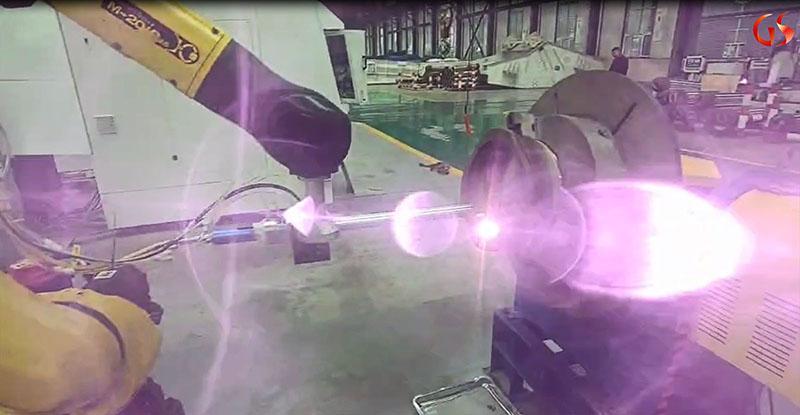
The process of laser cladding repair for guide sleeves mainly includes the following steps:
1. Preliminary Preparation
Before performing laser cladding repair, a detailed inspection and evaluation of the guide sleeve are necessary to determine the extent of wear and the repair plan. Simultaneously, the laser cladding equipment must be debugged and calibrated to ensure its stability and accuracy. Additionally, suitable alloy powder must be selected as the cladding material. Based on the material and usage environment of the guide sleeve, alloy powder with excellent performance should be chosen to ensure the quality and performance of the cladding layer.
2. Surface Pretreatment
Before laser cladding, the surface of the guide sleeve must undergo pretreatment. First, impurities such as oil stains and rust must be removed from the surface to ensure good bonding between the cladding layer and the substrate. Second, the surface of the guide sleeve must be roughened to increase surface roughness and enhance the bonding strength between the cladding layer and the substrate. Finally, the guide sleeve must be preheated to reduce thermal stress and deformation during the cladding process.
3. Laser Cladding Repair Processing
During laser cladding, the alloy powder must be evenly sprayed onto the surface of the guide sleeve and fused using the laser beam. The focusing and control of the laser beam are key to achieving high-precision coating formation. Parameters such as laser power, scanning speed, and scanning trajectory must be precisely controlled to ensure the quality and performance of the cladding layer. Simultaneously, real-time monitoring and feedback control of the cladding process are necessary to adjust parameters promptly in response to changes during the process.
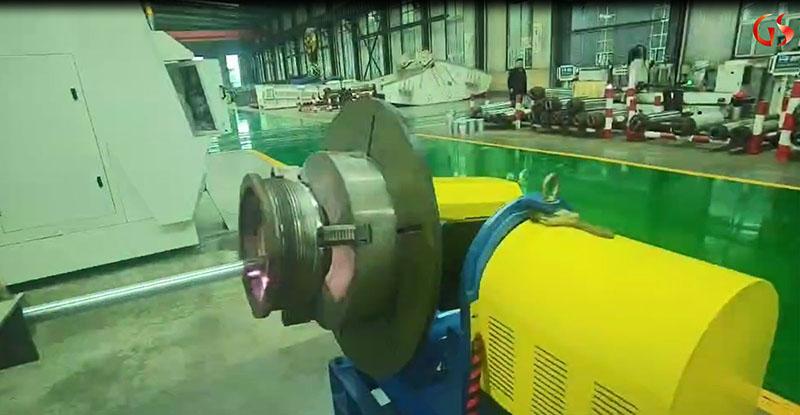
4. Post-Treatment
After laser cladding is completed, the cladding layer must undergo post-treatment. First, the cladding layer must be cooled to reduce thermal stress and deformation. Second, the cladding layer must be ground and polished to improve surface smoothness and accuracy. Finally, performance testing and evaluation of the cladding layer must be conducted, including hardness tests, wear resistance tests, and corrosion resistance tests, to verify whether the quality and performance of the cladding layer meet the requirements.
5. The advantages of laser cladding repair for guide sleeves are mainly reflected in the following aspects:
1. High Precision
Laser cladding technology enables high-precision coating formation, allowing precise control over coating thickness, shape, and dimensions. This is highly significant for the repair of precision components such as guide sleeves, ensuring that the repaired guide sleeve has the same accuracy and performance as the original part.
2. Low Heat-Affected Zone
The melting and solidification speeds during laser cladding are extremely fast, resulting in relatively small melting and heat-affected zones. This reduces the risk of thermal impact and deformation on the substrate material, ensuring that the repaired guide sleeve has good dimensional stability and shape accuracy.
3. Excellent Metallurgical Bonding
Laser cladding achieves excellent metallurgical bonding between the coating and the substrate material, with no significant cracks or interfaces between them. This ensures that the repaired guide sleeve has high strength and good durability.
4. Superior Coating Quality
Laser cladding produces high-density, dense, and uniform coatings, reducing the occurrence of pores, defects, and impurities. This enhances the coating's corrosion resistance, wear resistance, high-temperature resistance, and other properties, ensuring that the repaired guide sleeve has excellent overall performance.
5. Flexibility and Adaptability
Laser cladding is applicable to various metals, alloys, and composite materials, enabling cladding on different materials. This meets the repair needs of guide sleeves in various fields, offering broad application prospects.
The application scope of laser cladding repair for guide sleeves is very extensive. In fields such as mechanical manufacturing, aerospace, and energy equipment, guide sleeves, as critical components, have a significant impact on the overall machine's operational efficiency and service life due to the stability and durability of their performance. Through laser cladding repair technology, efficient and reliable repair of guide sleeves can be achieved, improving equipment operational efficiency and service life.
For example, in the mechanical manufacturing field, guide sleeves are commonly used in high-precision machine tools such as CNC machine tools and machining centers. These machine tools have very high requirements for the accuracy and performance of guide sleeves. Once defects such as wear or scratches occur, timely repair is necessary. Through laser cladding repair technology, high-precision repair of guide sleeves can be achieved, restoring their original accuracy and performance and ensuring the stable operation of the machine tools.
In the aerospace field, guide sleeves are often used in critical components such as aircraft engines and turbine blades. These components have very high requirements for material performance, needing properties such as high strength, high wear resistance, and high corrosion resistance. Through laser cladding repair technology, efficient and reliable repair of these components can be achieved, improving the performance and reliability of aircraft engines.
| Industry Category | Others |
|---|---|
| Product Category | |
| Brand: | 国盛激光 |
| Spec: | |
| Manufacturer: | 国盛激光 |
| Origin: | 116101 |


